

Twinning action for spreading excellence in Artificial Intelligence of Things
AIoTwin is a Horizon Europe project and twinning coordination action for
spreading excellence in Artificial Intelligence of Things




News
All news
2025-12-17 at 17:46,
3rd AIoTwin Summer School Video
3rd AIoTwin Summer School Video
As the year comes to a close, we look back at the 3rd AIoTwin Summer School, held in June in conjunction with the SpliTech 2025 Conference. The summer school brought together PhD students, researchers, and industry professionals to explore key challenges and advances in Artificial Intelligence of Things (AIoT), edge intelligence, and distributed AI systems. The programme featured a strong lineup of keynote lectures covering trustworthy decentralized infrastructures using blockchain technologies, human–robot interaction, and artificial intelligence–driven next-generation 6G networks. In addition, a series of in-depth tutorials addressed current research and practical challenges, including machine learning under data distribution shifts, neural network compression for resource-constrained devices, time-series forecasting methods, edge load-balancing strategies for multi-camera object tracking in urban traffic scenarios, and decentralized training of graph neural networks for vehicle speed prediction. Hands-on workshops showcased two open-source solutions developed within the AIoTwin ecosystem: the AIoTwin middleware for orchestrating hierarchical federated learning across large numbers of clients, and the SmartEdge toolchain for developing collaborative applications over dynamic, semantically described edge networks. The summer school also included a dedicated thematic session at the SpliTech 2025 Conference on Artificial Intelligence of Things and Edge Intelligence. Topics ranged from AIoT architectures and edge AI algorithms to real-time data processing, continual learning, security, privacy, energy efficiency, and communication protocols. Participants additionally had the opportunity to attend broader conference sessions, fostering networking and knowledge exchange across academia and industry. This video highlights the key moments, discussions, and collaborations that defined the 3rd AIoTwin Summer School and contributed to its success.

2025-12-16 at 21:31,
AIoTwin Results Presented at the 9th International Workshop on Advanced Cooperative Systems - IWACS 2025
AIoTwin Results Presented at the 9th International Workshop on Advanced Cooperative Systems - IWACS 2025
The main results and achievements of the AIoTwin project were presented on December 5, 2025 at the 9th International Workshop on Advanced Cooperative Systems (IWACS 2025) . The event was organized by the DATACROSS project and the Centre of Research Excellence for Data Science and Cooperative Systems at UNIZG-FER, providing a vibrant platform for engaging the national research community. Prof. Ivana Podnar Žarko, AIoTwin Project Coordinator, stressed that the project has successfully achieved its primary goal: to significantly strengthen the scientific excellence and innovation capacity of UNIZG-FER in the field of Artificial Intelligence of Things (AIoT) and edge AI. The following measurable achievements demonstrate the impact of the AIoTwin project in boosting research capacity and collaboration: 7 joint research papers co-authored with researchers from partner institutions 6 scientific trainings of doctoral students (short-term staff exchanges) at partner institutions in Europe 5 software components released as open-source software in the field of AIoT 4 project proposals with AIoTwin partners submitted to calls under Horizon Europe 3 successful international summer schools organized (Šibenik 2023, Dubrovnik 2024, Split 2025) Special attention was given to present key results from the project research component : the Orchestration Middleware for Cloud-Edge-IoT continuum. Prof. Podnar Žarko highlighted advancements in: Reactive Orchestration for Hierarchical Federated Learning : Methods for dynamically managing federated learning pipelines to ensure resilience and communication efficiency. QoS-Aware Load Balancing in the Computing Continuum : Techniques for maintaining predefined service quality metrics (QoS) across heterogeneous cloud and edge resources under variable workloads, nodes and network conditions.
2025-12-16 at 20:57,
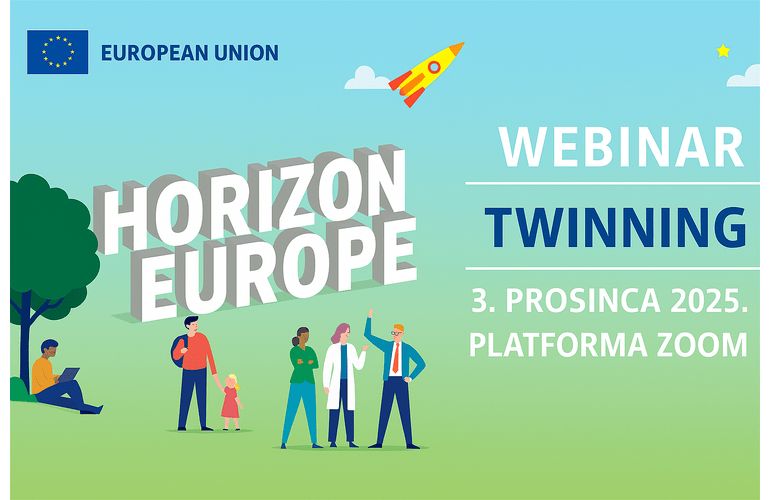
AIoTwin Coordinator Shares Experiences at National Twinning Webinar
AIoTwin Coordinator Shares Experiences at National Twinning Webinar
The AIoTwin project was represented on December 3, 2025 at the national webinar organized by the Agency for Mobility and Programs of the European Union, dedicated to the Twinning instrument of the Horizon Europe program . The event, which targeted researchers and administrative staff, focused on providing key information for achieving a successful Twinning application during the final call in 2026 under Horizon Europe. Prof. Ivana Podnar Žarko , AIoTwin Project Coordinator, participated as a panelist in the featured discussion and shared first-hand experiences from coordinating the AIoTwin Twinning project. The panel discussion offered comprehensive, practical advice covering the entire project lifecycle: Preparing a Winning Proposal : Strategies and key elements required for a successful application. Project Execution and Impact : Main challenges encountered during project execution and methods for maximizing research and institutional impact. Project Outcomes : Concrete examples of knowledge transfer and capacity building achieved through Twinning. AIoTwin is a prime example of how Twinning funding can be used to accelerate research capacities and build strong research networks in advanced fields such as AIoT, Edge AI, and the Cloud-Edge-IoT continuum.
2025-12-08 at 14:56,
Blog by Ivan Čilić: QoS-Aware Load Balancing for the Computing Continuum
Blog by Ivan Čilić: QoS-Aware Load Balancing for the Computing Continuum
IoT applications are increasingly pushing the limits of cloud-only architectures. From autonomous driving to real-time monitoring, many services need ultra-low latency and can’t rely on distant cloud servers alone. In our latest AIoTwin blog post, Ivan Čilić breaks down how the Computing Continuum (CC) can meet these demands—and why adaptive, QoS-aware load balancing is essential for reliable performance. This work comes from his doctoral research at FER and ongoing collaboration with the DSG Group at TU Wien as part of the AIoTwin project. Key highlights : How dynamic conditions in the CC break traditional load-balancing approaches Introducing QEdgeProxy — a decentralized, QoS-aware load balancer How QEdgeProxy uses local data to learn which service instances meet QoS requirements in real time How a Kubernetes-based implementation enables lightweight, scalable deployment Ivan’s work shows that decentralized QoS-aware load balancing is not only feasible but necessary to keep edge services responsive under real-world conditions. Read the full post here .

2025-12-02 at 13:18,
Blog by Ivan Kralj: Edge AI and Adaptive Learning Transform Smart Mobility
Blog by Ivan Kralj: Edge AI and Adaptive Learning Transform Smart Mobility
Cities today generate massive volumes of mobility data through sensors such as cameras, GPS, and roadside units. Traditional cloud-based systems struggle to process this data efficiently, particularly when real-time responsiveness is required. In a new AIoTwin blog post, Ivan Kralj explores how cloudlets , Edge AI , and adaptive learning are enabling scalable and accurate traffic prediction for smart cities. This work originates from Ivan’s research exchange in Sweden and ongoing collaboration with RISE Research Institutes of Sweden . Key Highlights: Traffic prediction is uniquely challenging due to the interconnected, dynamic nature of road networks. Fully centralized systems face limitations in scalability, latency, and reliability. Semi-decentralized training of Spatio-Temporal Graph Neural Networks (ST-GNNs) across distributed cloudlets improves resilience and efficiency. Sudden traffic events require specialized evaluation metrics — introducing Sudden Change in Speed Rate (SCSR) to detect congestion onset and recovery. Adaptive graph pruning reduces communication overhead while maintaining high prediction accuracy. Ivan’s research demonstrates that decentralized ST-GNN training is both practical and essential for future smart mobility systems, offering a more responsive and bandwidth-efficient approach to traffic prediction. Read the full post here .
2025-12-01 at 00:15,
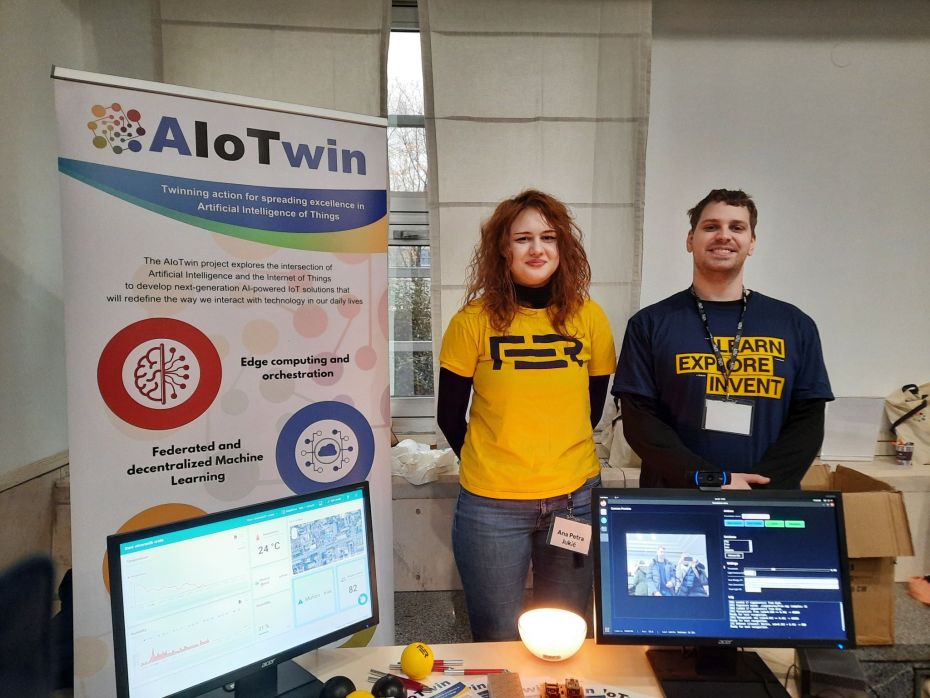
AIoTwin at the Open Door Event at UNIZG-FER
AIoTwin at the Open Door Event at UNIZG-FER
We were delighted to participate in the FER Open Door Day on November 22, 2025. The event was organized under the following motto: VISIT - EXPLORE - STAY ! We showcased our work, projects, and research, including activities within the 𝗔𝗜𝗼𝗧𝘄𝗶𝗻 project. Through demonstrations and conversations with prospective students, we highlighted how our technologies contribute to the future of STEM and the broader community. Thank you to everyone who stopped by and engaged with us. We look forward to future opportunities to connect and inspire!
2025-12-01 at 00:00,
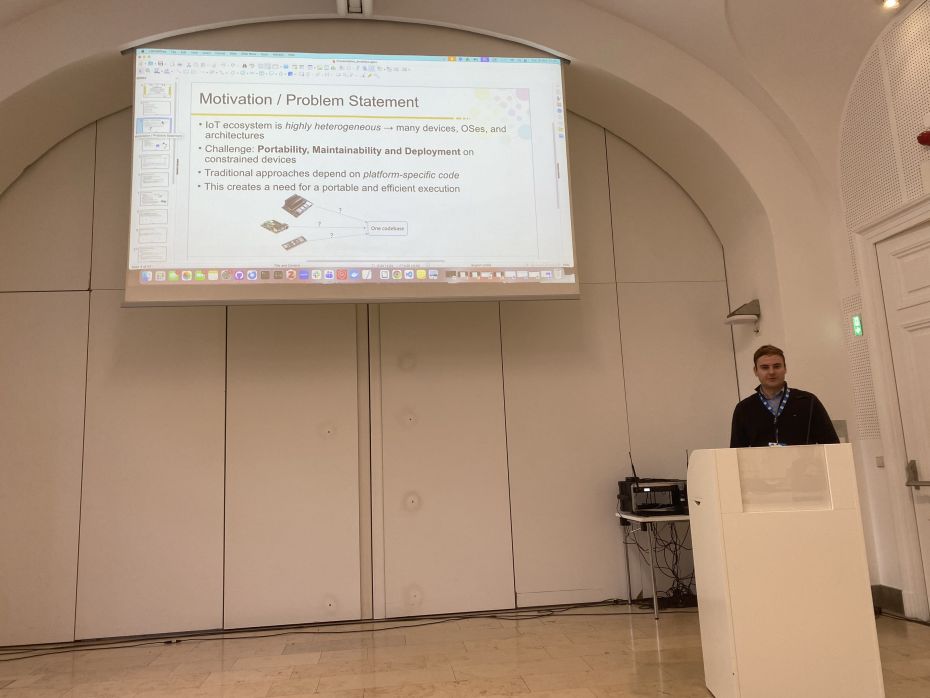
New paper presented at the ScaleSys workshop at IoT 2025
New paper presented at the ScaleSys workshop at IoT 2025
At the ScaleSys Workshop co-located with the IoT 2025 Conference , held from 18–21 November in Vienna, Austria , the paper “WebAssembly on Resource-Constrained IoT Devices: Performance, Efficiency, and Portability” was presented by Mislav Has . The paper is authored by Mislav Has, Tao Xiong, Fehmi Ben Abdesslem, and Mario Kušek . The work results from a collaboration with RISE , focusing on the experimental evaluation of WebAssembly technologies for deployment on highly resource-constrained IoT devices. The paper investigates the feasibility and practical implications of running WebAssembly (WASM) on such constrained platforms. It provides an in-depth experimental evaluation of lightweight WASM runtimes on microcontrollers with only kilobytes of RAM, focusing on trade-offs between performance, memory usage, energy efficiency, and portability. The study compares WASM execution with native C implementations for representative IoT workloads, offering insights into when WASM is a viable alternative and when native code remains necessary.
2025-11-21 at 10:08,
New AIoTwin Blog Post: Handling Dynamics in HFL Pipelines: The Need for Adaptive Orchestration
New AIoTwin Blog Post: Handling Dynamics in HFL Pipelines: The Need for Adaptive Orchestration
A new article titled “Handling Dynamics in HFL Pipelines: The Need for Adaptive Orchestration” , authored by Ana Petra Jukić , has been published as part of the ongoing AIoTwin project blog series . The article reflects work carried out during and following the author’s short-term exchange at Technische Universität Berlin , focused on advanced orchestration strategies for Hierarchical Federated Learning (HFL). The text discusses key challenges arising in dynamic environments, where HFL pipelines may become suboptimal due to node arrivals or departures, fluctuations in resource availability, or non-uniform data distributions. It outlines the importance of adaptive orchestration and provides an overview of the AIoTwin orchestration middleware , developed on Kubernetes, which monitors performance, resource usage, and cost metrics to support intelligent and timely reconfiguration of HFL pipelines. The article also presents the Reconfiguration Validation Algorithm (RVA) , a method used to assess whether newly applied configurations offer real improvements without exceeding defined budget constraints. The full article is available here .
2025-11-10 at 13:34,
Hierarchical Federated Learning: Scaling Distributed Intelligence Beyond the Cloud
Hierarchical Federated Learning: Scaling Distributed Intelligence Beyond the Cloud
The AIoTwin project has released a new article in its ongoing blog series, focusing on Hierarchical Federated Learning (HFL) - an emerging approach designed to enhance the scalability and efficiency of distributed learning across Cloud-Edge-IoT (CEI) environments. While traditional Federated Learning (FL) enables collaborative model training without sharing raw data, it often faces limitations in scalability and communication efficiency. HFL addresses these challenges by introducing an intermediate layer of edge aggregators , creating a robust, multi-tier learning architecture that supports more decentralized and resilient AI applications. The blog post, authored by Katarina Vuknić following her research exchange at the Distributed Systems Group (DSG) , TU Wien , as part of the AIoTwin project , explores several key aspects of HFL: Communication Efficiency: How HFL significantly reduces uplink communication costs compared to flat FL architectures. Trade-offs: Analyzing challenges such as convergence delay, gradient variance, and model divergence in multi-level aggregation setups. Real-World Impact: Demonstrating the use of HFL in applications like smart farming and intelligent traffic management systems. The AIoTwin Solution: Presenting the open-source Extension of the Flower Framework for HFL , a Python-based component that enables scalable client, local, and global aggregation across the CEI continuum. The AIoTwin HFL solution offers a flexible, modular implementation of federated learning services designed to support distributed AI orchestration from the edge to the cloud. It represents a key step forward in advancing open, adaptive, and privacy-preserving machine learning for next-generation intelligent systems. The full article is available here .
2025-11-07 at 12:23,
New blog: AI Meets the Physical World: AIoT in Action with AIoTwin
New blog: AI Meets the Physical World: AIoT in Action with AIoTwin
A new blog post has been published focusing on the Artificial Intelligence of Things (AIoT) and the outcomes of the AIoTwin project. AIoT is revolutionizing the way humans and systems interact with the physical world by embedding intelligence directly into devices — from city cameras to industrial sensors. By integrating AI across Cloud-Edge-IoT (CEI) environments, AIoT enables systems that can learn, reason, and make autonomous decisions in real time. However, this transition from cloud-only or edge-only AI to a full computing continuum introduces new challenges, including determining where AI models should run — in the cloud, at the edge, or across both. The first blog post, authored by Ivana Podnar Zarko , explores several key aspects: Real-time traffic monitoring as a practical AIoT use case Cloud vs. edge-based AI: accuracy, latency, network load, and privacy trade-offs Why hybrid deployments across the computing continuum are the future Key technical challenges: optimal service placement, dynamic routing, federated learning, fault tolerance, and model updates As a solution, the AIoTwin Orchestration Middleware has been introduced. Developed by researchers at IoTLab@FER (Ivan Čilić, Ana Petra Jukić, Katarina Vuknić) in collaboration with researchers from Technische Universität Wien (Pantelis Frangoudis, Anna Lackinger, Ilir Murturi, Alireza Furutanpey, Schahram Dustdar), the middleware delivers a suite of open-source tools — including the fl-orchestrator , Flower extension for HFL , and QEdgeProxy . These tools form the foundation for scalable, adaptive, and intelligent AIoT deployments spanning from the edge to the cloud. The full blog post is available here , with additional technical articles from consortium members to follow.
Coordinator:

Partners:



Number of visits:
45343
45343